GRP Cable Ladders & Trays
Corrosion-free cable support in pultruded glass-fibre reinforced polyester for chemical, offshore, energy and outdoor projects. Lighter than steel, non-conductive and self-extinguishing, designed to IEC 61537, NEMA FG-1 and UL 94 V-0.
Cable support that does not corrode
Where steel would rust, need repainting or need earthing, GRP keeps working for the life of the plant. Our own GRP production adds pultruded glass-fibre cable ladders and trays to the CASK Steel cable management range: one manufacturer, one item-number logic for ladders, trays, fittings, covers and fixings.
Why GRP
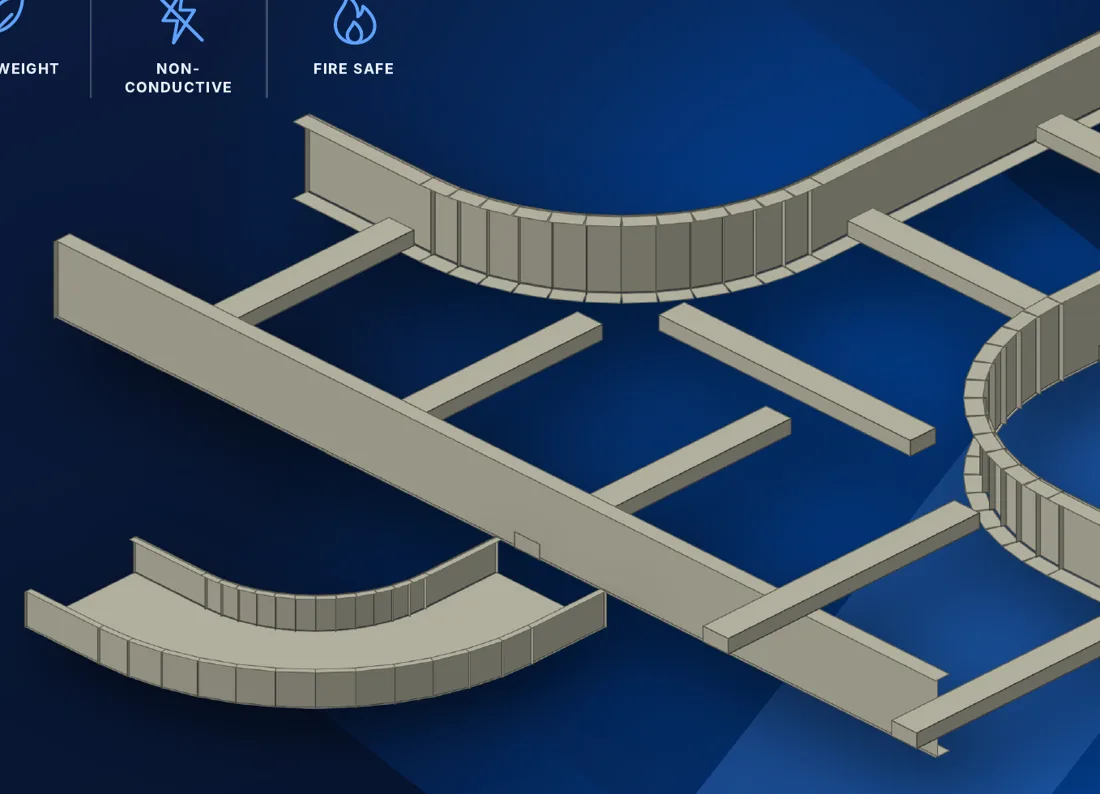
Corrosion resistant
Withstands acids, alkalis, salt spray and most industrial chemicals. No galvanizing, painting or touch-up over the life of the plant.
Light and easy to install
Density about 1.75 g/cm³, around 40% lighter than steel systems. Cut and drill on site with standard tools, no hot work.
Fire safe
Self-extinguishing to UL 94 V-0, Class 1 to ASTM E84 and BS 476-7, B1 to DIN 4102-1. Zero halogen and low smoke.
Electrically safe
Non-conductive, dielectric strength 7.2 kV/mm, so no earthing or bonding is needed. Anti-static versions on request.
Strong over long spans
Side rails classified NEMA 12C (H100) and NEMA 20C (H150), for support spans up to 6 m and fewer supports.
Built for harsh sites
UV-stabilised, at least 1,500 hours neutral salt spray, from very low temperatures up to 94 °C continuous.
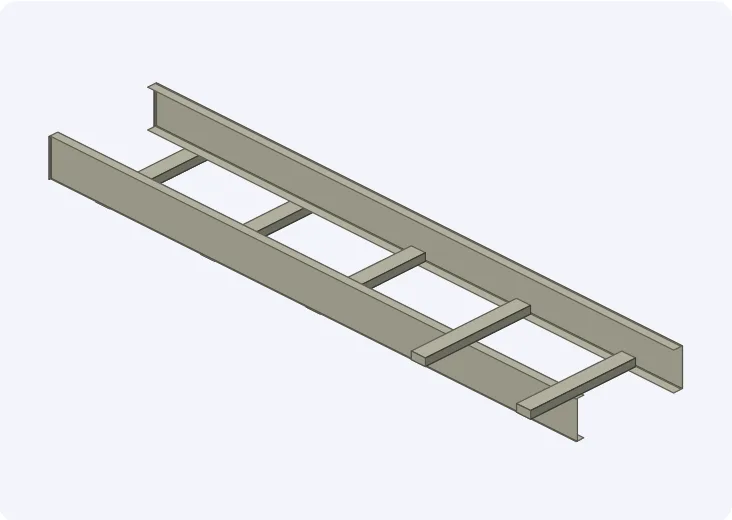
GRP cable ladder (CGR-LD)
Pultruded C-section side rails with rungs every 300 mm, for heavy, long-span cable routes.
- Side-rail heights 55, 80, 100 and 150 mm
- Widths 150 to 900 mm, lengths 3 m and 6 m
- Bends 45° and 90° (R300 – R900), tees, crosses, risers, reducers, covers
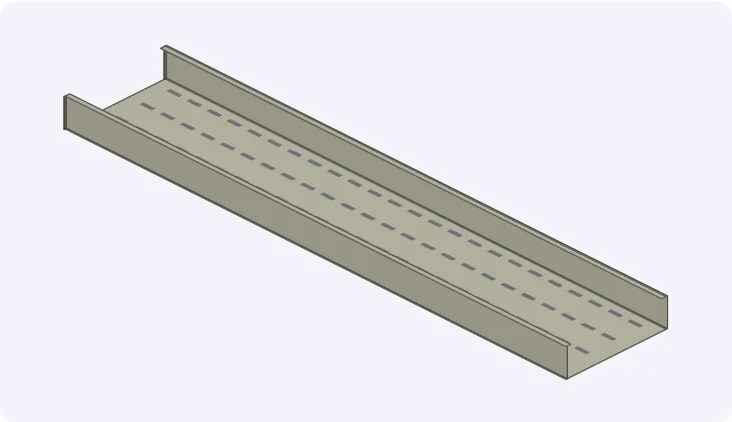
GRP cable tray (CGR-TR)
One-piece pultruded channel with a perforated base for ventilation, or a solid base for full cable protection.
- Side heights 50, 80 and 100 mm
- Widths 50 to 600 mm, 3 m lengths
- Wall 3 mm up to 300 mm wide, 4.5 mm from 400 to 600 mm
A complete system from one manufacturer
Ladders and trays share the same covers, splice plates and stainless fixings, and every bend, tee, cross, riser and reducer is made in the same material, so a complete cable route can be ordered in one go. Sizes, loads, weights and the item number of every part are in the catalogue: English (PDF) · العربية (PDF)
Material and standards
- Material: halogen-free polyester resin, pultruded, RAL 7032 pebble grey; vinyl ester for stronger chemicals and anti-static versions on request
- Mechanical: tensile strength 325 MPa, impact 10 J, density 1.73 g/cm³
- Fire: UL 94 V-0, glow-wire 960 °C, ASTM E84 Class 1, DIN 4102-1 B1, EN 45545-2 R6 (railway)
- Electrical: surface resistivity above 10¹² Ω, dielectric strength 7.2 kV/mm, tracking index 575 V
- Load design: IEC 61537 multi-span tests and NEMA FG-1 load classes
- Chemical resistance: the catalogue includes a full guide by chemical, concentration and temperature
Where GRP is used
Frequently asked questions
When should I choose GRP instead of galvanized steel?
In chemical, coastal, offshore, water-treatment and tunnel sites where galvanized steel corrodes, where non-conductive cable support avoids earthing and bonding, or where a lighter system saves installation time. Our engineers advise for each project.
What loads and spans can GRP ladders carry?
H100 ladders are NEMA 12C (149 kg/m at 3.6 m span) and H150 ladders NEMA 20C (149 kg/m at 6.0 m span). Safe working loads to IEC 61537 for each size are supplied with the technical submittal.
Can GRP be used at high temperature?
Yes, up to 94 °C continuous. Above normal ambient temperatures a reduction factor is applied to the loads; the catalogue gives the factors and the spacing of expansion joints.
Is the catalogue available in Arabic?
Yes. Download the English or Arabic catalogue at the top of this page.
Related products
Planning a cable route in a corrosive site?
Send us your route, cable loads and the chemicals present. We will propose the GRP system, the spans and the fittings.
CASK Electric © 2026
Address: Çerkeşli Mah. Tavşancıl Sok. No: 72
Dilovası, Kocaeli, Türkiye
Phone: +90 216 410 22 44
Email: [email protected]
About
Divisions
Products
Catalogues & Brochures
Product Categories