Steel Conduit Systems
Rigid, intermediate, EMT, metric and flexible steel conduit with the fittings, conduit bodies and supports that complete the route, from 1/2" to 6" and 16 to 32 mm. Made to ANSI, UL, EN and BS standards.
One conduit system for every route
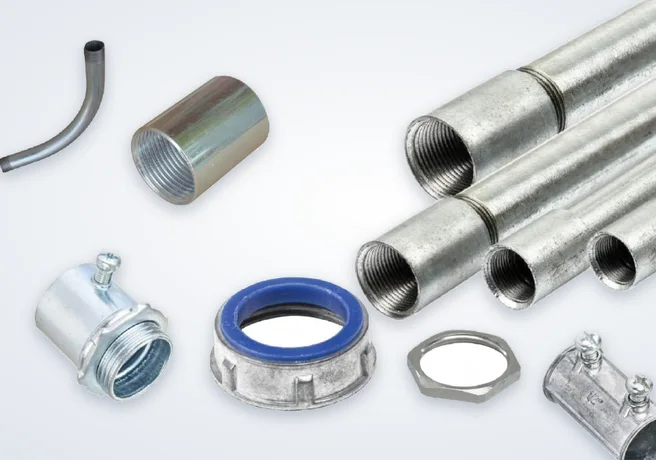
From heavy-wall rigid conduit for buried and hazardous-area runs to light EMT for buildings and flexible conduit for the last metre into a motor, the CASK Steel range covers the whole conduit route with matching fittings and supports. Every part number shows the product, the trade size and the finish, so offers, orders and the catalogue always match.
The conduit types
Rigid steel conduit (RSC)
The heaviest wall, threaded both ends, for exposed, buried, concrete-encased and hazardous-area runs. ANSI C80.1 and UL 6, 1/2" to 6".
Intermediate metal conduit (IMC)
The same thread and fittings as rigid conduit and about one third lighter. ANSI C80.6 and UL 1242, 1/2" to 4".
Electrical metallic tubing (EMT)
Thin-wall unthreaded tubing for buildings, joined with set-screw or compression fittings and bent on site. ANSI C80.3 and UL 797.
Metric heavy gauge conduit
Welded steel conduit for BS and IEC projects in the Gulf, Africa, the UK and Europe. EN 61386-21 and BS 4568-1, 16 to 32 mm.
Flexible and liquid-tight conduit
Interlocked galvanized steel strip, bare or with a PVC jacket, for motors, vibrating equipment and wet or oily connections.
Fittings, bodies and supports
Couplings, elbows, bushings, reducers, unions, conduit bodies, boxes, straps, hangers and clamps for every conduit type.
Finishes and standards
- Hot-dip galvanized: zinc coated inside and out after threading, to ANSI C80.1 / C80.6 and EN ISO 1461; standard for rigid, intermediate and metric conduit
- Pre-galvanized: zinc outside and a protective coating inside; standard for EMT
- Stainless steel 304 / 316L: for food, pharmaceutical, coastal and offshore sites
- Aluminium: rigid conduit to ANSI C80.5, light, non-magnetic and non-sparking
- Fittings: UL 514B; grounding bushings to UL 467; NPT threads to ANSI/ASME B1.20.1
Where it is used
Choosing the right conduit
The catalogue includes a selection guide by conduit type and site, the matching fittings and supports for each conduit, installation steps (cut and ream, bend, join, bond) and support spacing. Sizes, weights and the part number of every item are in the catalogue: English (PDF) · العربية (PDF)
Frequently asked questions
When should I choose rigid conduit instead of EMT?
Rigid and intermediate conduit are threaded and heavier, for outdoor, buried, concrete-encased and hazardous-area runs. EMT is lighter and quicker to install in buildings, with compression fittings in wet areas. The project specification and local wiring rules decide.
Do you supply metric conduit for BS and IEC projects?
Yes. Heavy gauge class 4 steel conduit to EN 61386-21 and BS 4568-1 in 16, 20, 25 and 32 mm, with couplers, circular boxes and spacer bar saddles.
Is the catalogue available in Arabic?
Yes. Download the English or Arabic catalogue at the top of this page.
Related products
Planning a conduit route?
Send us your drawings or bill of quantities. We will propose the conduit, fittings and supports with their part numbers.
CASK Electric © 2026
Address: Çerkeşli Mah. Tavşancıl Sok. No: 72
Dilovası, Kocaeli, Türkiye
Phone: +90 216 410 22 44
Email: [email protected]
About
Divisions
Products
Catalogues & Brochures
Product Categories