

Cable Ladders

Steel cable ladders from CASK STEEL carry heavy power cables over long distances between supports. We make them in light, medium, standard and heavy duty, out-flanged and flexible, from 100 to 1,000 mm wide, with every bend, tee, cross and reducer in the same sizes. Made in our factory in Dilovası, Kocaeli, in accordance with IEC 61537.
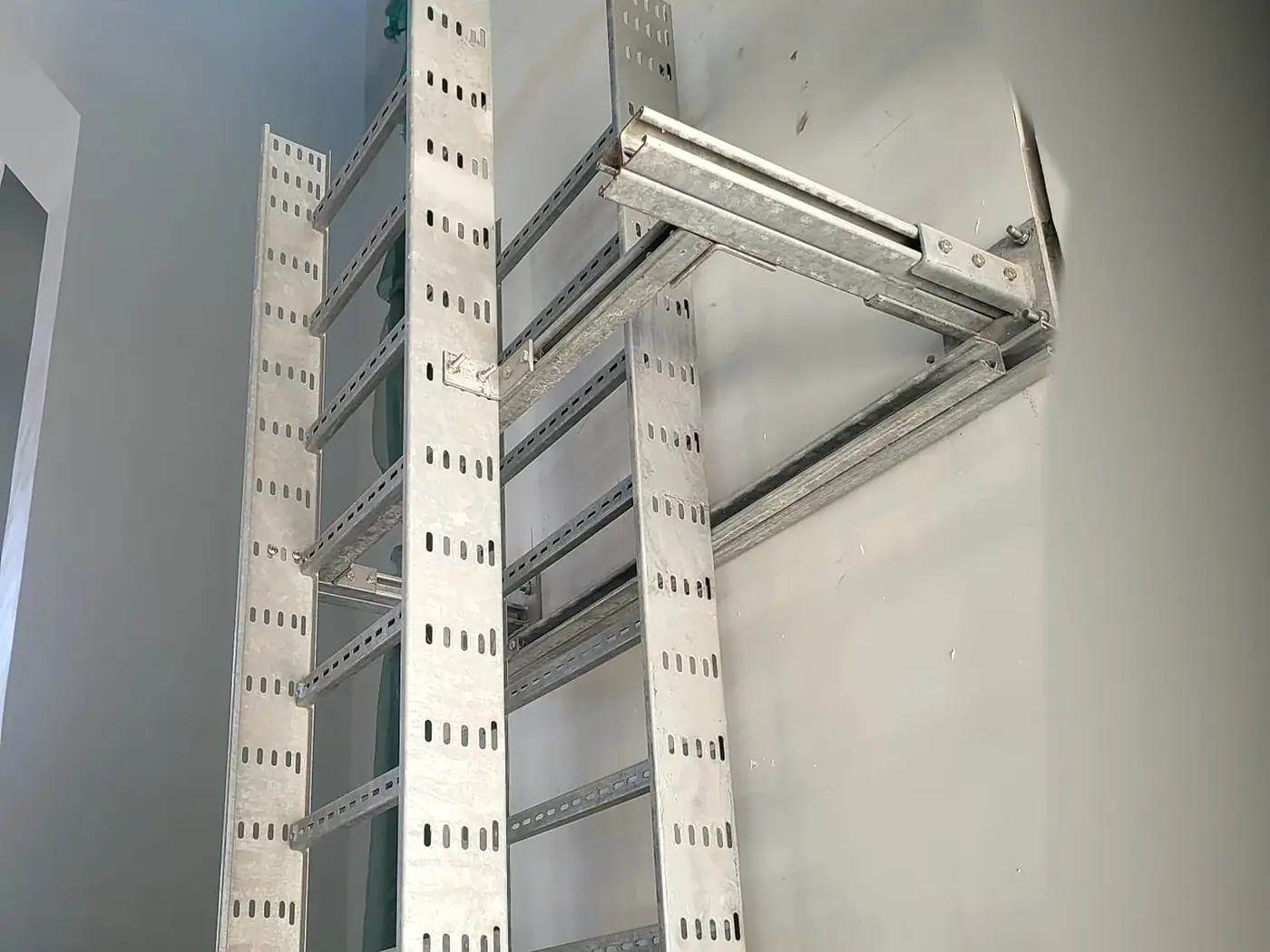
What a cable ladder is, and when to choose one
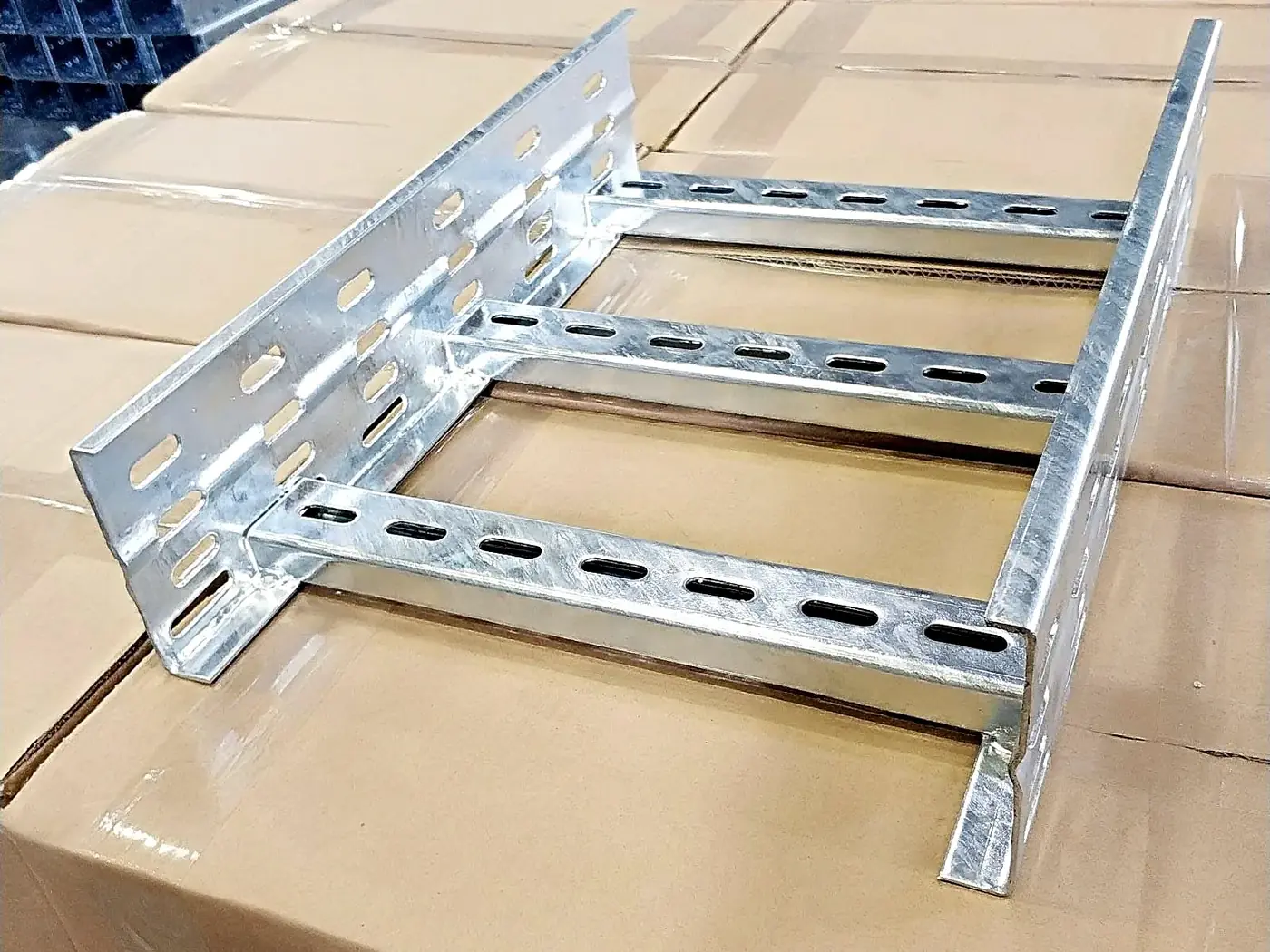
A cable ladder is two steel side rails joined by rungs every 300 mm. The cables lie on the rungs, so air moves freely around them on all sides. This matters most for power cables: a cable that can shed its heat can carry its full rated current, while a cable packed in a closed tray may need to be de-rated.
The side rails work as two beams. Because they are deep and stiff, a ladder can bridge a longer distance between supports than a perforated tray of the same width, so a route needs fewer supports.
Choose a cable ladder when:
- the route carries large power cables (main feeders, transformer and generator cables, MV cables)
- the distance between supports is long, for example across a pipe rack, a cable bridge or a tunnel wall
- the cables need good ventilation, outdoors or in hot plant rooms
- cables must enter or leave the route at many points (the open rungs make this easy)
Choose a perforated or solid cable tray instead when the cables are small (control, instrument, data) and need support along their whole length, or need protection from below.
Types of cable ladder we make
Every type has its own base number. The width, side height, sheet thickness and finish follow it in the part number.
| Type | Base number | Width W (mm) | Side height H (mm) | Sheet thickness T (mm) | Typical use |
|---|---|---|---|---|---|
| Light duty | CST-CL049 | 100 to 900 | 50, 70, 75 | 1.5 | Short spans, light power and control cables in buildings |
| Medium duty | CST-CL060 | 100 to 900 | 100 | 1.5 | General industrial routes, medium cable loads |
| Standard | CST-CL002 | 100 to 900 | 75 to 150 | 1.5 to 2.5 | The widest range of sizes for most projects |
| Heavy duty | CST-CL003 | 100 to 1,000 | 100, 125, 150 | 2.0 to 2.5 | Large power cables, long spans, power plants, oil and gas |
| Out-flanged, heavy duty | CST-CL071 | 100 to 900 | 100, 125, 150 | 2.0 | Stiff profile with its own couplers and brackets, for heavy outdoor routes |
| Flexible | CST-CL082 | 200 to 600 | 60 | 1.5 | Short runs around obstacles where a fixed bend does not fit |
Rung spacing is 300 mm on every type. The rungs are slotted, so cables can be tied or clamped at any point. Standard length is 3,000 mm; selected sizes are also made in 2,500 mm. Other sizes are made to order.
Weight per metre (straight sections, hot-dip galvanized)
| Side height H x thickness T | W 100 | W 300 | W 600 | W 900 |
|---|---|---|---|---|
| H 50 x 1.5 mm | 2.3 kg/m | 2.7 kg/m | 3.3 kg/m | 3.9 kg/m |
| H 70 x 1.5 mm | 2.8 kg/m | 3.2 kg/m | 3.8 kg/m | 4.4 kg/m |
| H 100 x 1.5 mm | 4.0 kg/m | 4.6 kg/m | 5.5 kg/m | 6.4 kg/m |
| H 125 x 2.0 mm | 6.1 to 6.9 kg/m (W 150 to 750) | |||
| H 150 x 2.0 mm | 7.1 to 7.9 kg/m (W 150 to 750) | |||
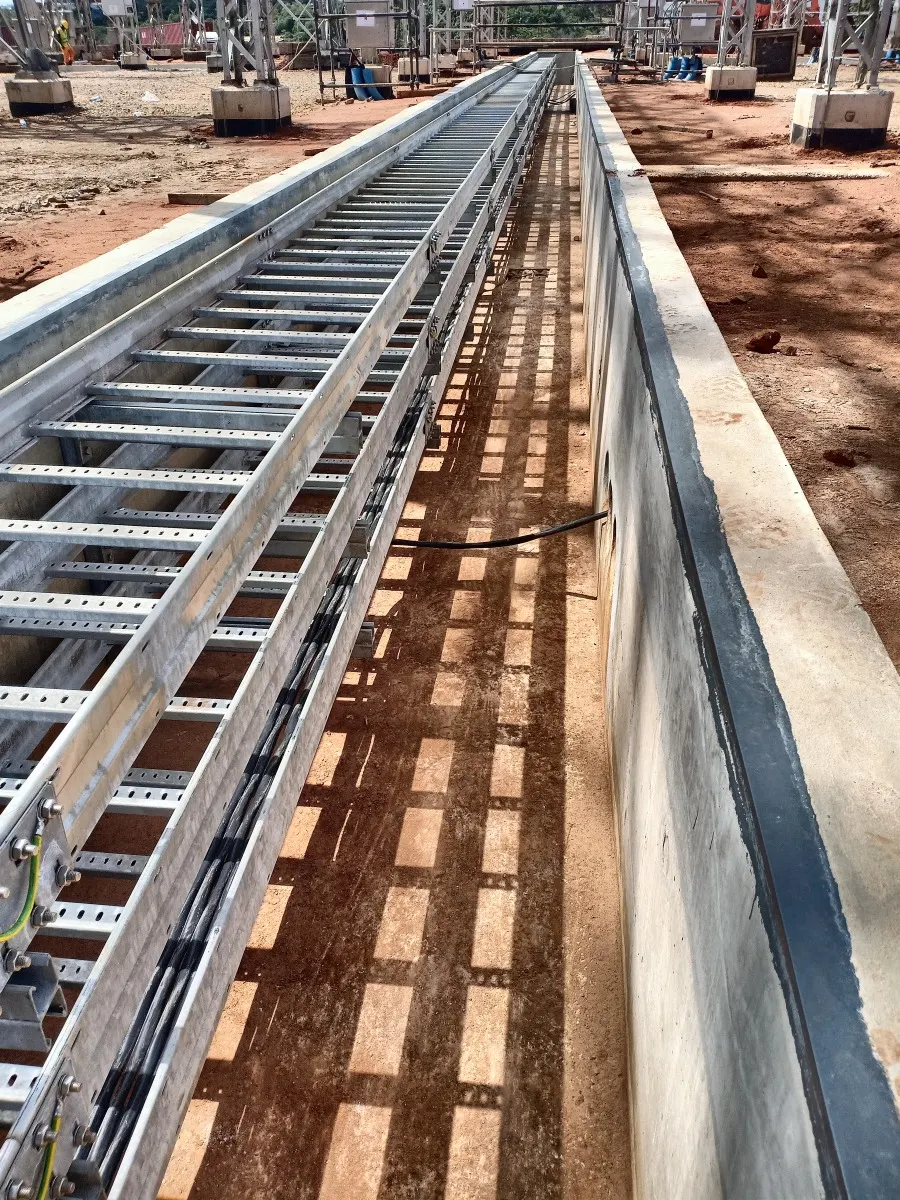
What decides how much a cable ladder can carry
A ladder's load capacity is not one number. It depends on the ladder itself and on how it is supported. The main factors, in order of effect:
- Distance between supports (span). This has the biggest effect. When the span gets longer, the bending in the side rails grows much faster than the span itself. Doubling the span cuts the safe load to well under half. Keeping the span short is the cheapest way to carry more cable.
- Side rail height. A deeper side rail is a much stiffer beam. Going from 100 mm to 150 mm side height raises the load capacity far more than going from 1.5 mm to 2.0 mm steel.
- Sheet thickness. Thicker steel adds strength and resists local damage at the joints and supports. Heavy-duty ladders use 2.0 and 2.5 mm.
- Position of the joints. A splice plate is weaker than the solid side rail. Load ratings assume joints are close to a support, not in the middle of a span.
- Type of load. Cables spread along the ladder give a uniform load. A heavy single item at mid-span, such as a large cable gland box, is much harder on the ladder than the same weight spread out.
- Width. A wider ladder carries more cables, but the side rails still carry all of it. The rungs must also carry the cable weight across the width, so very wide ladders with heavy cables need the heavy-duty types.
The finish (galvanized, zinc-magnesium, stainless steel) does not change the strength of the same size. It decides how long the ladder lasts in its environment.
Safe working load to IEC 61537, in plain words
IEC 61537 is the international standard for cable tray and cable ladder systems. It defines the safe working load (SWL): the uniformly distributed load, in kilograms per metre, that a ladder can carry over a given span.
The ladder is tested with joints and supports in place, and the load is increased step by step. The SWL is the load at which the ladder still meets two limits:
- it bends down by no more than 1/100 of the span in the middle (for a 3 m span, 30 mm)
- it bends sideways across its width by no more than 1/20 of the width
The standard allows different test arrangements, mainly where the joint sits in the span. The same ladder can therefore show different SWL values depending on the test. When you compare ladders from different makers, always compare the same span and the same test arrangement.
Span and supports: how to plan the route
The span is the distance between two supports. Most ladder routes use spans between 1.5 m and 3 m. As a general rule:
- Light and medium-duty ladders suit spans up to about 1.5 to 2 m with moderate cable loads.
- Standard and heavy-duty ladders suit spans up to 3 m and heavy power cables.
- For very heavy routes, a shorter span with the same ladder is often cheaper than a bigger ladder.
How to choose the width and side height
Width
For power cables laid in one layer, add up the outside diameters of the cables, add the gaps you need between them, and add about 20 to 25% for future cables. Then choose the next standard width. Cable diameters are in each cable's data sheet.
Side height
The side rail should be higher than the largest cable lying in the ladder, so cables stay inside the rails at bends and tees. For one layer of large power cables, 100 mm side height is the usual minimum.
Bend radius
Large power cables cannot be bent tightly. Each cable's data sheet gives its minimum bending radius (often 12 to 15 times the cable diameter for power cables). The inside radius of the ladder bend must not be smaller. Our ladder bends are made with radius 150 to 2,000 mm.
Fittings
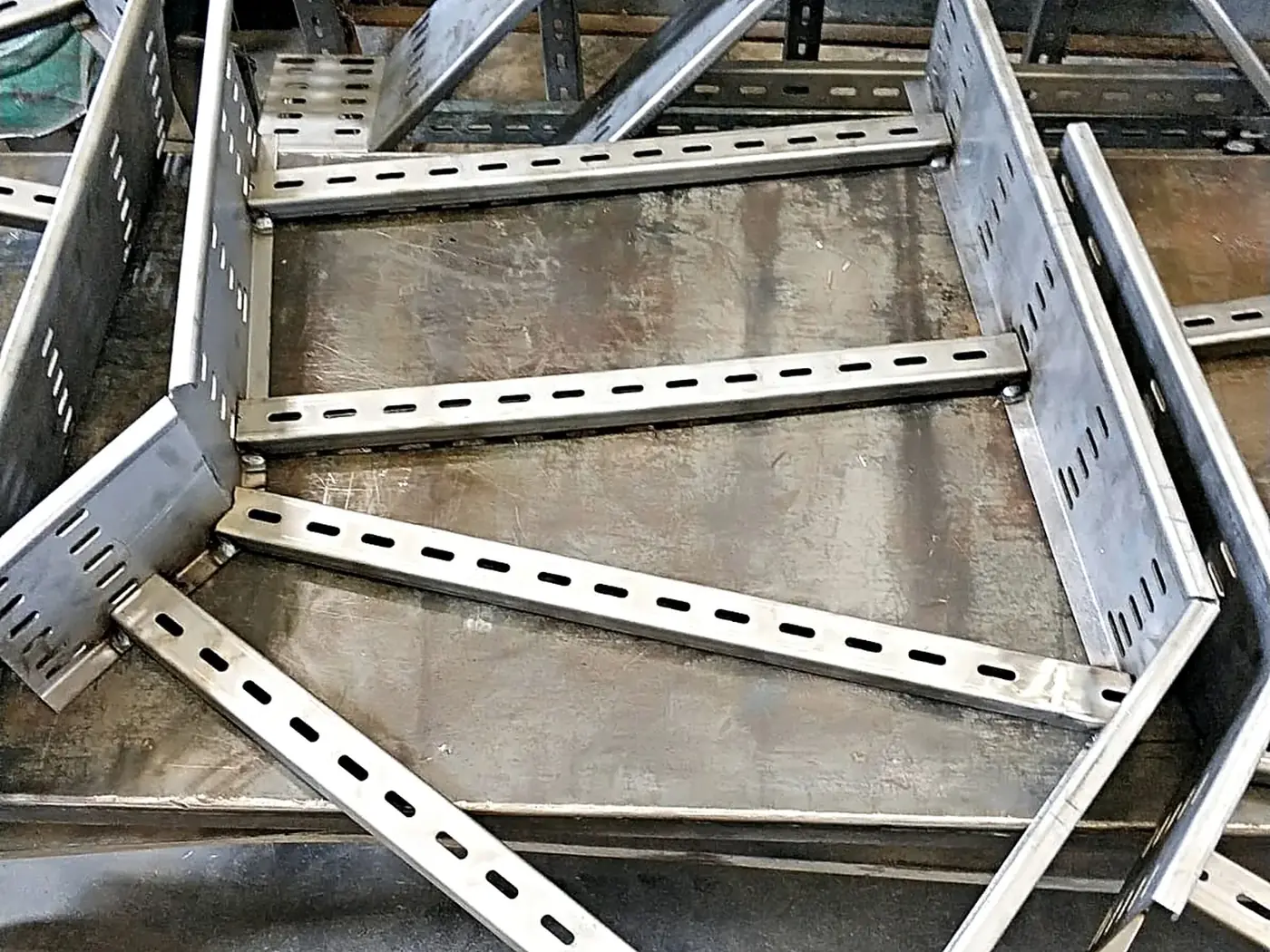
All fittings are made for each ladder type, in the same widths, side heights and thicknesses as the straight sections.
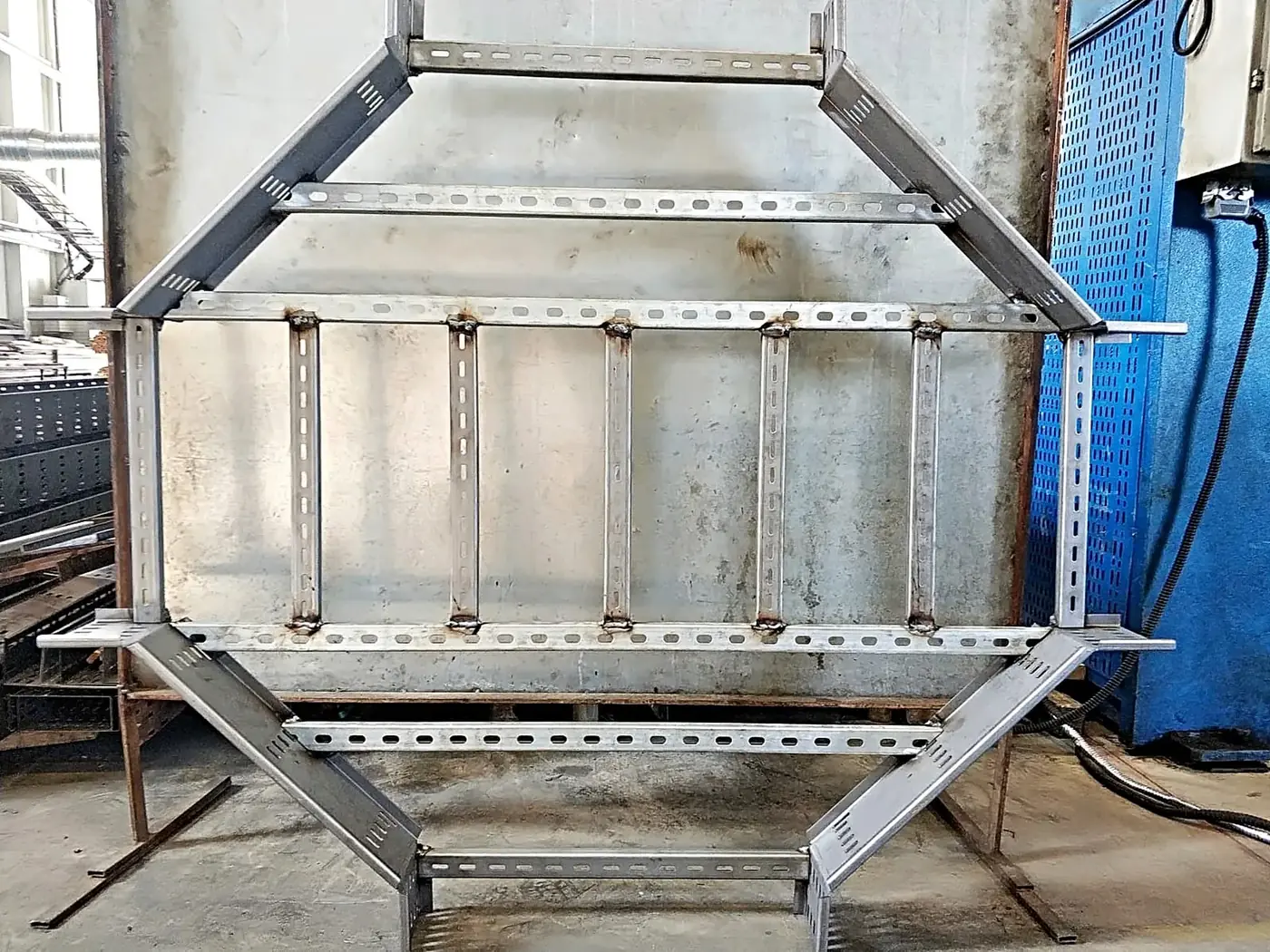
- Horizontal: 45° and 90° flat bends (CST-CL008, CL009, CL020, CL021, CL050, CL062, CL072), equal tees (CST-CL030, CL031, CL051, CL061, CL073), unequal tee (CST-CL032), crosses (CST-CL036, CL053, CL063, CL074)
- Reducers: straight, left and right, for every duty (for example CST-CL039, CL037, CL038 heavy duty)
- Vertical: vertical tee (CST-CL033), 45° and 90° vertical inside and outside bends (for example CST-CL011, CL013, CL023, CL024)
- Covers for ladders, flat, ventilated or peaked, are in part 1 of the catalogue (CST-CT041, CT047, CT044)
- Splice plates, couplers, end plates, brackets and hold-down clips are in part 4, supports and accessories
Materials and finishes, by environment
Hot-dip galvanized is the standard finish. Every ladder type is available in all finishes. The finish code is the last part of the part number.
| Code | Finish | Where to use it |
|---|---|---|
| -HDG | Hot-dip galvanized after fabrication, EN ISO 1461 (standard) | Outdoor and industrial sites, corrosivity class C4 |
| -PG | Pre-galvanized strip, EN 10346 (Z275) | Dry indoor areas, C1 to C2 |
| -ZM | Zinc-aluminium-magnesium coated steel, EN 10346, up to about 3 times the life of HDG, self-healing cut edges | Severe outdoor and coastal sites, C4 to C5 |
| -EP | Hot-dip galvanized, then epoxy or polyester powder coated (RAL colour on request) | Coastal and chemical sites, C5, or where a colour is required |
| -SS304 | Stainless steel AISI 304 | Food and pharma plants, wet indoor areas, C3 to C4 |
| -SS316 | Stainless steel AISI 316L | Offshore, marine and chemical plants, C5 |
| -AL | Aluminium: light and non-magnetic | Indoor and outdoor, C3, where low weight matters |
Use the same finish for the ladder, its fittings, splice plates and bolts. Mixing stainless steel with galvanized parts outdoors causes corrosion at the contact points.
Worked example
A plant needs a main power route along a pipe rack outdoors, near the coast. Supports are every 3 m. The route carries 8 power cables, each 40 mm in outside diameter and about 5 kg/m (from the cable data sheets).
- Width: 8 cables x 40 mm, plus one cable diameter between each pair (7 x 40 mm) = 600 mm. With spare space for future cables, choose W 750.
- Side height: largest cable 40 mm, one layer, 3 m span and heavy cables: H 125.
- Load: 8 x 5 kg/m = 40 kg/m of cables, plus a margin for future cables: plan for about 50 kg/m over a 3 m span. A heavy-duty ladder, 2.0 mm, is the right type.
- Finish: coastal and outdoor, so zinc-magnesium (-ZM) or, for the longest life, stainless steel 316 (-SS316).
Part number: CST-CL003-750-125-2.0-ZM (heavy-duty cable ladder, width 750, side height 125, 2.0 mm, zinc-magnesium).
How to read and order a part number
Every CASK Steel part number describes the product. Read the size from the catalogue table, then add the finish code.
| Part | Example | Meaning |
|---|---|---|
| Base number | CST-CL003 | Heavy-duty cable ladder |
| Width W | 250 | 250 mm |
| Side height H | 150 | 150 mm |
| Thickness T | 2.0 | 2.0 mm steel |
| Radius (bends only, where more than one is made) | R600 | 600 mm bend radius |
| Length (only if not 3,000 mm) | L2500 | 2,500 mm length |
| Finish | HDG | Hot-dip galvanized |
Examples: CST-CL049-250-70-1.5-HDG (light duty), CST-CL071-250-125-2.0-HDG (out-flanged heavy duty), CST-CL008-250-75-1.5-HDG (45° flat bend). Numbers from our earlier catalogues and offers remain valid and are linked to the new numbers.
Summary
| If you need | Choose |
|---|---|
| Light cables, short spans, indoor | Light duty CST-CL049, pre-galvanized or HDG |
| General industrial routes | Medium duty CST-CL060 or standard CST-CL002, HDG |
| Large power cables, spans up to 3 m | Heavy duty CST-CL003, 2.0 to 2.5 mm, side height 125 or 150 |
| Heavy outdoor routes on pipe racks | Out-flanged heavy duty CST-CL071 |
| A short run around an obstacle | Flexible ladder CST-CL082 |
| Coastal or chemical site | -ZM, -EP or -SS316 finish |
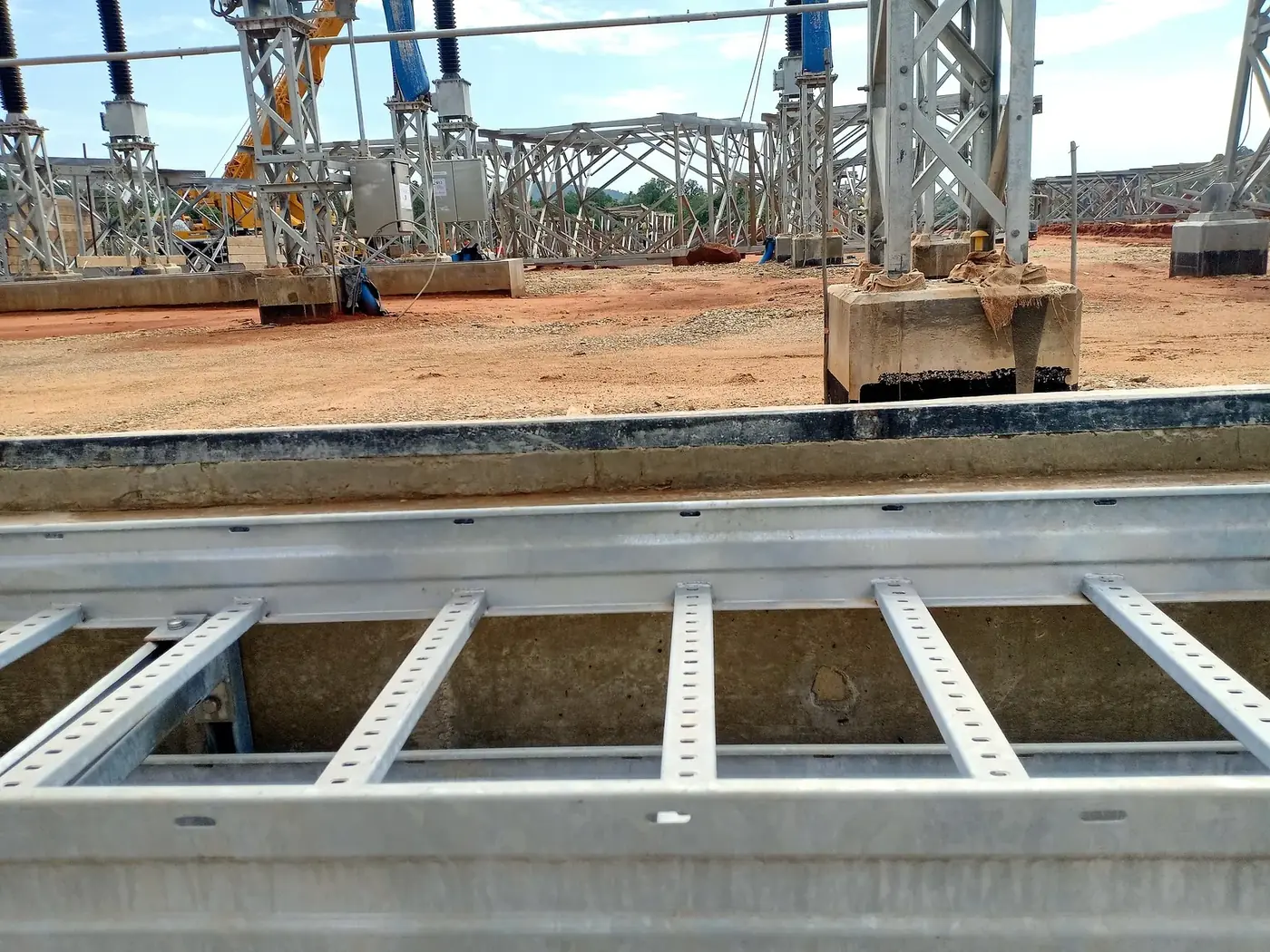
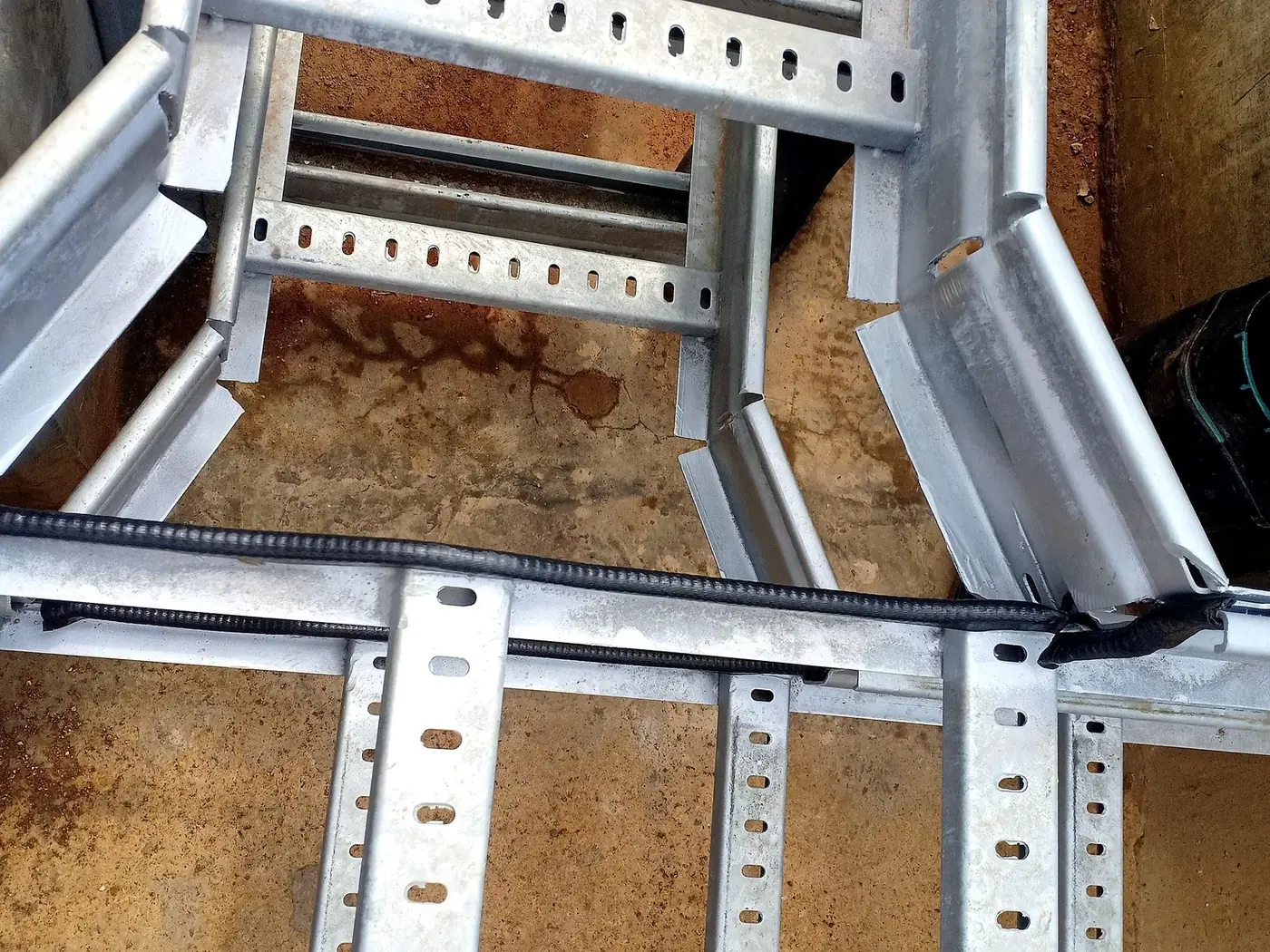
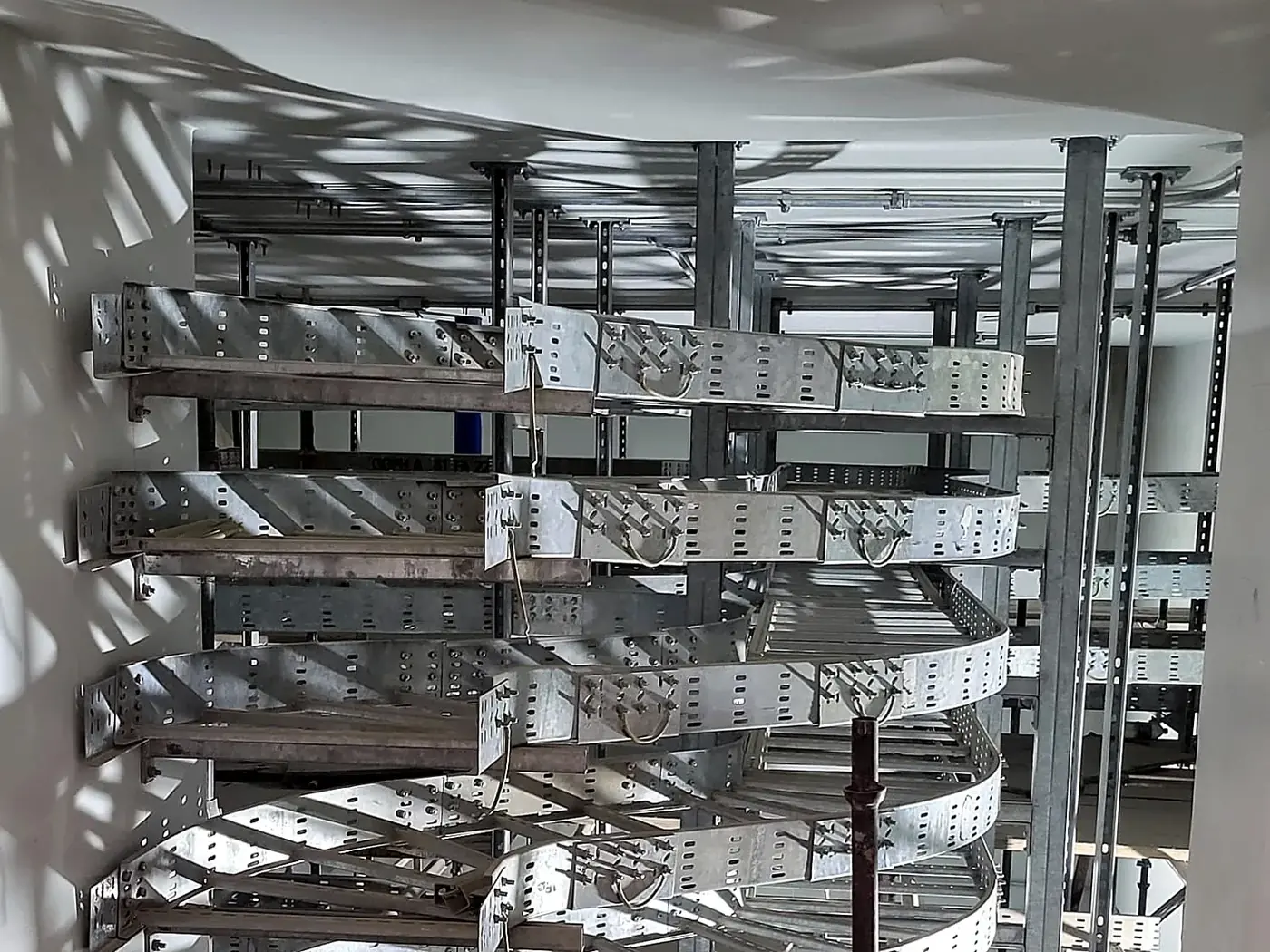
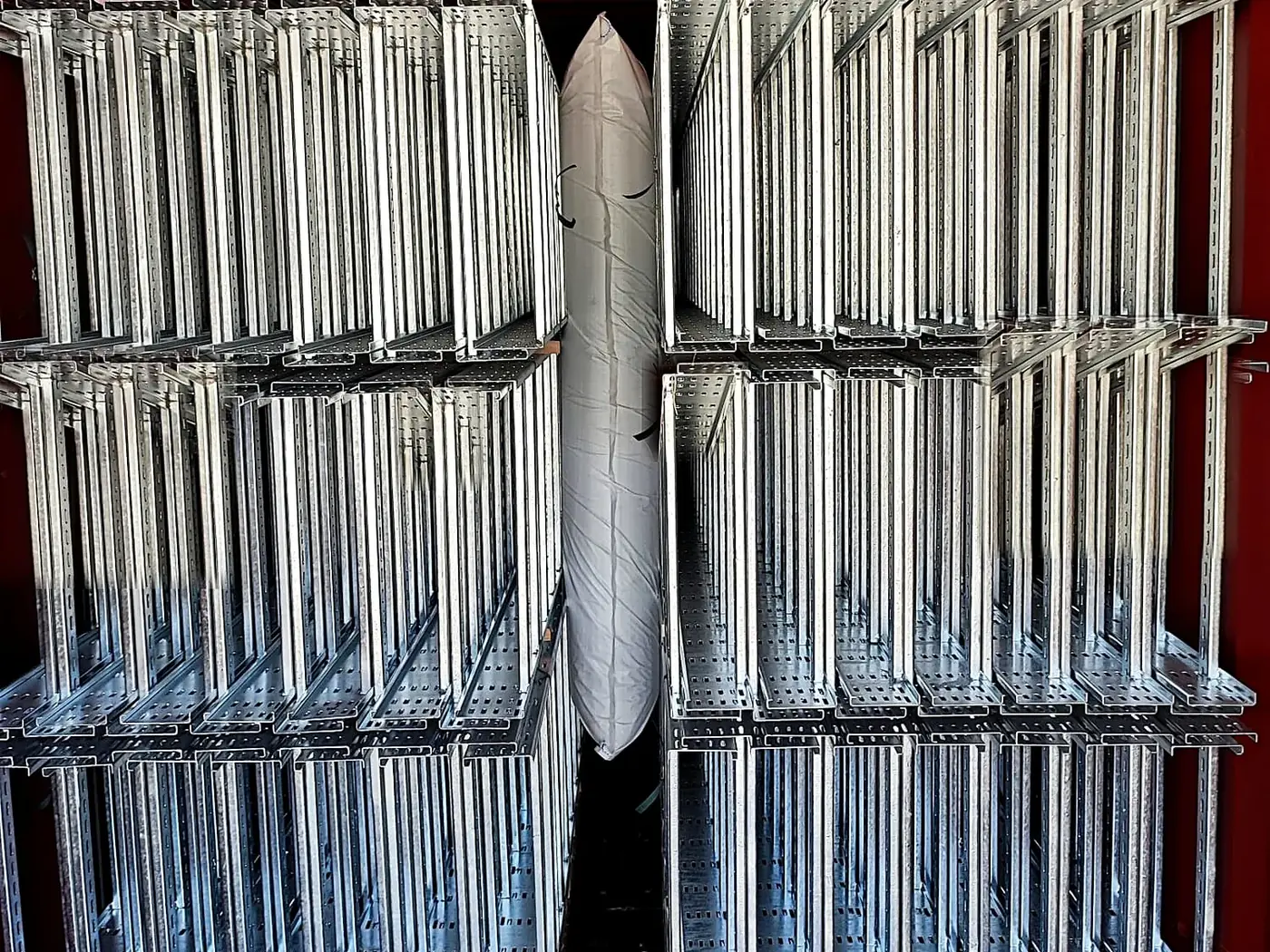
Our cable ladders on site
Frequently asked questions
What is the difference between a cable ladder and a cable tray?
A ladder has open rungs between two deep side rails; a tray has a continuous base. Ladders give more ventilation and bridge longer spans with heavy power cables. Trays support small cables along their whole length.
How far apart should the supports be?
Usually 1.5 to 3 m, depending on the ladder type and the cable load. A shorter span lets the same ladder carry much more.
What does safe working load mean?
It is the evenly spread load, in kg per metre, that a ladder carries over a given span while staying within the bending limits of IEC 61537. It always belongs to a span: the same ladder has a lower safe working load on a longer span.
Is a thicker ladder always stronger?
Thicker steel helps, but side rail height helps much more. A 150 mm side rail is far stiffer than a 100 mm one of the same thickness.
Can I put cables in more than one layer?
Small cables can be laid in layers. Large power cables are normally laid in one layer, so they can lose their heat; check the cable maker's rating method.
Which finish lasts longest near the sea?
Stainless steel AISI 316L lasts longest. Zinc-magnesium (-ZM) and HDG with powder coating (-EP) are good, lower-cost choices for coastal sites.
Do you make sizes that are not in the catalogue?
Yes. Other widths, side heights, lengths and radii are made to order.
Do you supply the fittings and accessories with the ladders?
Yes. Bends, tees, crosses, reducers, covers, splice plates, brackets and bolts are supplied with the ladders, in the same finish.
Downloads
Cable ladders catalogue, part 2 (PDF) · العربية (PDF) · Full cable management catalogue (PDF)
Related products
Questions about this product? Contact us
CASK ELECTRIC © 2026
Factory: Çerkeşli Mah. Tavşancıl Sok. No: 72, Dilovası, Kocaeli
Email: [email protected]